
New center for quantum technologies aims to link fundamental research with applications
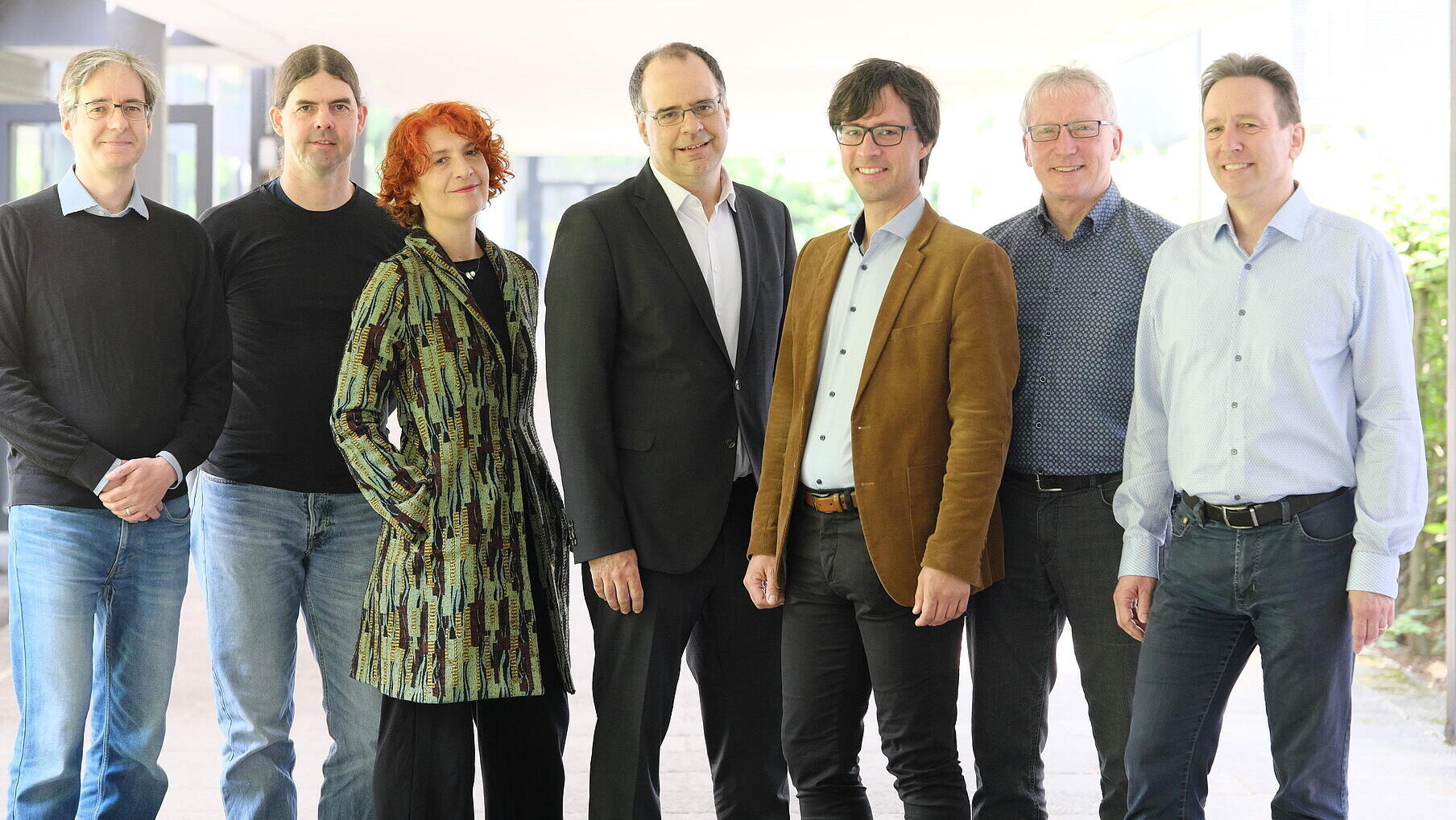
The leadership team of the new Center for Quantum Technologies from physics, mathematics, and computer science (from left to right): Peter P. Orth, Markus Bläser, Giovanna Morigi, Frank Wilhelm-Mauch, Moritz Weber, Jürgen Eschner, and Christoph Becher. Not pictured: Jonas Haferkamp, who is also part of the leadership team.
The Saarland state government announced last June that it would support the establishment of a Center for Quantum Technologies (QuTe) at Saarland University with more than €53 million in funding. Today, the center officially begins its work with a ceremonial kick-off event. Among those attending are Minister Jakob von Weizsäcker, University President Ludger Santen, and Astrid Lambrecht, Chair of the Board of Directors of Forschungszentrum Jülich, which will work closely with the new center.
The Center for Quantum Technologies aims to combine fundamental research with practical applications. One focus area is quantum engineering and quantum optics, with the goal of developing a quantum internet, quantum networks, and interfaces. A second focus will address quantum information theory, quantum algorithms, and the computer science and software of quantum computing.
The center is fundamentally interdisciplinary and adopts a broad understanding of quantum technologies, bridging physics, mathematics, computer science, and engineering. Existing expertise from professors in these four fields at Saarland University will be expanded through new appointments. These will build on the university’s long-standing research in quantum optics as well as experimental and theoretical physics. These research groups are already playing a key role in developing quantum networks and a future “quantum internet.”
In quantum engineering, the aim is to connect fundamental physics research with application-oriented systems engineering, thereby translating research results into practical applications. To achieve this, two additional professorships in experimental quantum physics and eight in systems engineering are planned. Forschungszentrum Jülich will serve as a renowned partner, establishing a branch on the Saarbrücken campus focused on quantum engineering, creating joint professorships, and contributing its internationally recognized infrastructure.
Once fully developed, the Center for Quantum Technologies will cover the entire value chain—from basic research to application—in quantum engineering. It will be one of the few locations where quantum physics and engineering are brought together as equal partners under one roof. Significant contributions are expected in the development of technologies for quantum networks and quantum computer hardware.
In the second focus area, quantum computing, Frank Wilhelm-Mauch conducts research as a professor at Saarland University in collaboration with Forschungszentrum Jülich (the “Jülich model”). He coordinates large integrated research initiatives and serves as a key interface between quantum software and hardware. Theoretical quantum technology and quantum information are already represented at the university by four professorships across physics, computer science, and mathematics. These will be strengthened by two additional professorships in quantum information within computer science and one in mathematics. Together with a planned professorship in quantum communication within systems engineering, the center will cover the interdisciplinary field of quantum information with unusual breadth. Additionally, a joint professorship with the German Research Center for Artificial Intelligence (DFKI) in the area of quantum artificial intelligence will be established—further positioning Saarland as a pioneer.
Even now, the Center for Quantum Technologies—working closely with the internationally renowned computer science community at Saarland University—makes an important contribution to closing the research gap in quantum software and algorithms. In the future, software for quantum computing and industrial applications will be developed, for example through hybrid algorithms that combine classical high-performance computing with quantum computing methods.
“Our goal is to create a globally visible hub for quantum technologies on the Saarland University campus, distinguished by both excellent fundamental research and application-oriented development,” says University President Ludger Santen. In particular, the field of quantum engineering is expected to drive technological developments, patents, and start-ups. There is also strong potential for start-ups in the software sector. New algorithms will be needed to enable quantum computers to solve certain problems more efficiently than classical systems. “To train specialists in these areas, Saarland University will expand its existing Bachelor’s and Master’s programs in Quantum Engineering—offered since 2019—by adding a Master’s program in quantum information starting in the winter semester. This program will not require a physics background and will also be open to students from computer science and mathematics,” Santen adds.
Science Minister Jakob von Weizsäcker also emphasizes the economic importance of the new center for Saarland: “What began 100 years ago with quantum mechanics as a revolution in theoretical physics is now a key technology with enormous economic potential. The new Center for Quantum Technologies builds on existing strengths at our university and, together with Forschungszentrum Jülich, creates the critical mass needed for international visibility and competitiveness. With support from the Saarland transformation fund, we are establishing a technological lighthouse with strong spillover effects for value creation and jobs.”
Astrid Lambrecht adds at the kick-off event in Saarbrücken: “Innovative quantum technologies emerge in networked ecosystems—driven by talent and close collaboration between university and non-university research. With support from the state, the new center at Saarland University creates optimal conditions for this and strengthens scientific excellence. The cooperation with Forschungszentrum Jülich provides early-career researchers with access to powerful infrastructure connected to real-world applications. In this way, we aim to actively strengthen the quantum computing community in Germany.”
At today’s kick-off event for the Center for Quantum Technologies, starting at 4:00 p.m. in the Innovation Center of Saarland University, mathematics professor Moritz Weber will present insights into past and planned activities on behalf of the QuTe leadership team. This will be followed by perspectives from Minister Jakob von Weizsäcker, University President Ludger Santen, and Astrid Lambrecht. The keynote lecture will be given by the German-Austrian experimental physicist Rainer Blatt. Dorothee Bär, Federal Minister for Research, Technology and Space, will send a video message.
The founding directorate of the Center for Quantum Technologies includes Christoph Becher (Physics), Markus Bläser (Computer Science), Jürgen Eschner (Physics),Giovanna Morigi (Physics), Peter Orth (Physics), Moritz Weber (Mathematics) as Senior Director and Frank Wilhelm-Mauch (Physics).
More Information:
https://www.uni-saarland.de/forschen/quantentechnologien.html
Questions answered:
Prof. Dr. Moritz Weber
Tel.: 0681-302-2556
E-Mail: weber(at)math.uni-sb.de