

Two scientists from MPI for Informatics receive high honors from the Eurographics Association
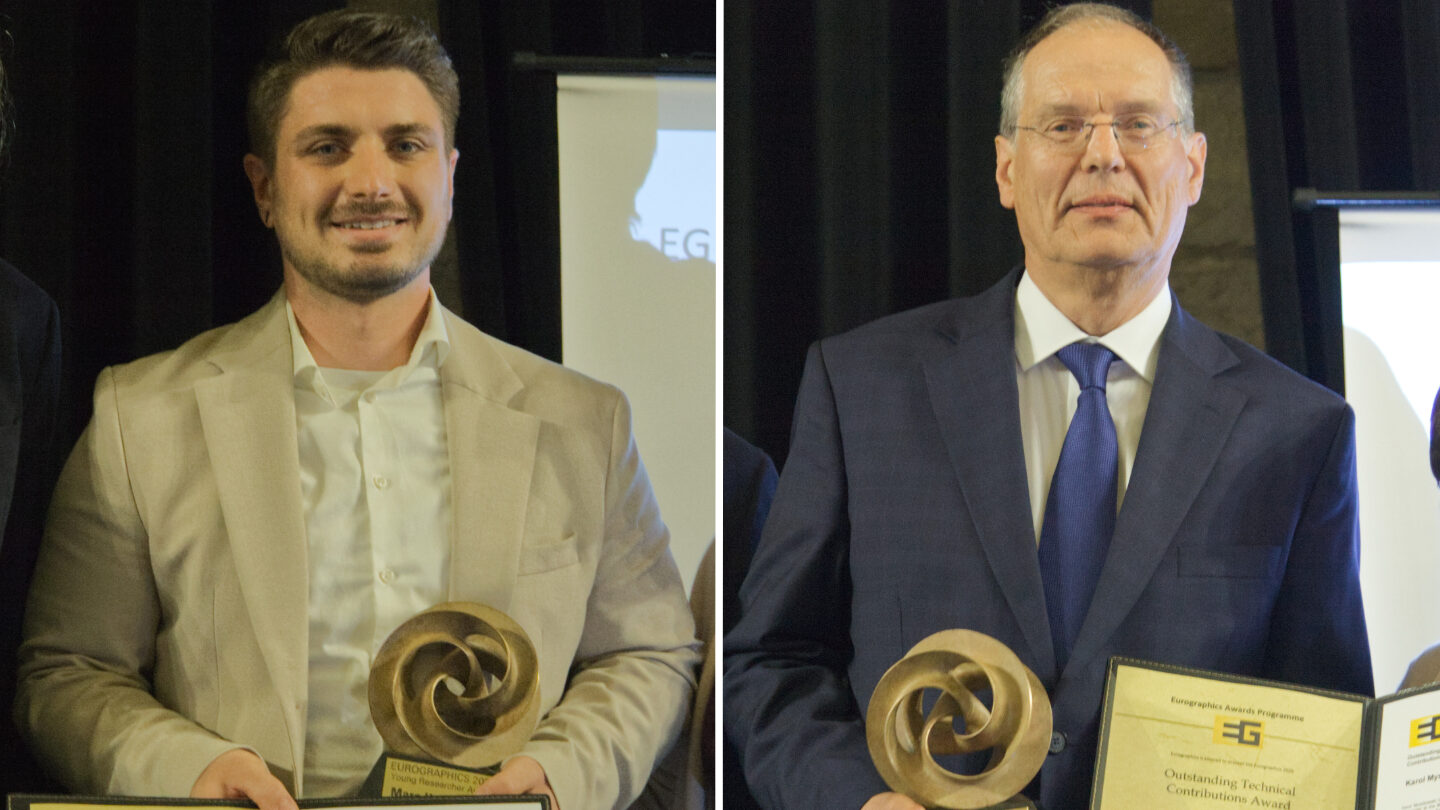
Marc Haberman receiving his award from Eurographics President Michela Spagnulo (right) and award comitee member Diego Gutierrez (left). Photo: Eurographics
Prof. Dr. Karol Myszkowski is being honored with the “Outstanding Technical Contributions Award” from the European Association for Computer Graphics. This is the highest technical distinction in the European computer graphics community. Dr. Marc Habermann receives one of the two “Young Researcher Awards,” which annually recognize the most outstanding early-career scientists. The Eurographics Conference 2026 takes place from May 4 to 8 in Aachen, Germany.
Karol Myszkowski is honored with the Eurographics Outstanding Technical Contributions Awardfor his long-standing and impactful work in computer graphics research. The laudation notes that his work “[…] for decades has helped shape how we understand, model, and visualize the world,” and that his contributions have made him one of the most relevant researchers in the field in Europe. His research bridges the gap between graphics and perception “with exceptional elegance and technical soundness, defining standards of excellence in many fields,” particularly in high dynamic range imaging (HDR), a technique for representing images with especially high contrast and detail. Among other things, Karol Myszkowski is co-author of the book High Dynamic Range Imaging: Acquisition, Display, and Image-Based Lighting, which has since become a standard reference for students, researchers, and practitioners alike.
Furthermore, he is well-known for his work on image quality analyses and metrics. He has also made fundamental contributions to so-called “perceptual rendering,” developing methods of image generation guided by human perception that restrict detail reconstruction to what is perceptually discernible.
Other important research areas in which he has made important contributions include stereoscopic imaging, where a slightly different image is generated for each eye, creating 3D depth in films or VR applications, as well as the realistic rendering of materials. More recently, he has increasingly focused on virtual reality research. Overall, his work has helped to use computational resources more efficiently.
In addition to his scientific work, Myszkowski is deeply involved in the professional community. In 2020, he chaired the Technical Papers Program of SIGGRAPH Asia and is active in numerous committees and editorial boards. Particularly noteworthy is his commitment to supporting early-career researchers, where he is regarded as a role model through his mentorship and scientific integrity.
Karol Myszkowski has been conducting research at the Max Planck Institute for Informatics since 2000, where he leads the research group “HDR Imaging, Rendering and Advanced Displays” as a senior researcher. Prior to that, he worked for many years in Japan, including as an associate professor at the University of Aizu. His academic career began at the Szczecin University of Technology. He received his PhD in 1991, followed by his habilitation in 2001, both in computer science at the Warsaw University of Technology. In 2011, he was awarded a lifetime professor title by the President of the Republic of Poland. In 2025, he was already named a Eurographics Fellow and inducted into the ACM SIGGRAPH Academy, the latter being among the highest international honors in computer graphics research.
The “Young Researcher Award” for Marc Habermann underscores the role of the Max Planck Institute for Informatics in promoting internationally leading research in computer graphics.
The award recognizes Habermann’s significant contributions to human performance capture, digital human reconstruction, and photorealistic human rendering. His work innovatively combines computer graphics, computer vision, and machine learning, as highlighted in the laudation.
During his doctoral research, Marc Habermann introduced “LiveCap,” the first method capable of generating a detailed, movable 3D model of a human, including clothing deformations, from image data captured by a standard camera, such as those found in smartphones. He subsequently developed “DeepCap,” the first learning-based framework for high-fidelity human performance capture, for which he received a CVPR Best-Paper Honorable Mention. Currently, Marc Habermann is researching how classical computer graphics methods can be combined with machine learning approaches (neural-explicit methods) to create even more realistic and efficient digital humans. Such technologies could be used in the future for virtual meetings, games, films, and anywhere digital humans play a role.
Habermann’s research findings have been published in the most important conferences and leading journals in computer graphics and computer vision, including SIGGRAPH, ACM Transactions on Graphics, CVPR, ICCV, ECCV, EUROGRAPHICS, and NeurIPS. His work has received multiple awards, including the EUROGRAPHICS PhD Award, the DAGM MVTec Dissertation Award, and the Otto Hahn Medal from the Max Planck Society.
Since 2017, the Saarland native has been conducting research at the Max Planck Institute for Informatics, initially as a doctoral student in the group of Professor Christian Theobalt. After earning his doctorate in November 2021, he began leading the “Graphics and Vision for Digital Humans Group” and serving as the Scientific Manager of the Real Virtual Lab in the Visual Computing and Artificial Intelligence department headed by Director Christian Theobalt. In December 2024, he was appointed Senior Researcher at the Institute.
Further Information:
Karol Myszkowski’s Website: https://people.mpi-inf.mpg.de/~karol/
Award citation for Karol Myszkowski: https://www.eg.org/wp/eurographics-awards-programme/the-outstanding-technical-contributions-award/outstanding-technical-contributions-award-2026-karol-myszkowski/
Website of the Graphics and Vision for Digital Humans group: https://gvdh.mpi-inf.mpg.de/
Award citation for Marc Habermann: https://www.eg.org/wp/eurographics-awards-programme/the-young-researcher-award/young-researcher-award-2026-marc-habermann/
Website of the Real Virtual Lab: https://www.mpi-inf.mpg.de/de/departments/visual-computing-and-artificial-intelligence/real-virtual-lab
Website of the Eurographics Conference 2026: https://eg2026.github.io/
Editor:
Philipp Zapf-Schramm
Max Planck Institute for Informatics
Phone: +49 681 9325 4509
Email: pzs@mpi-inf.mpg.de