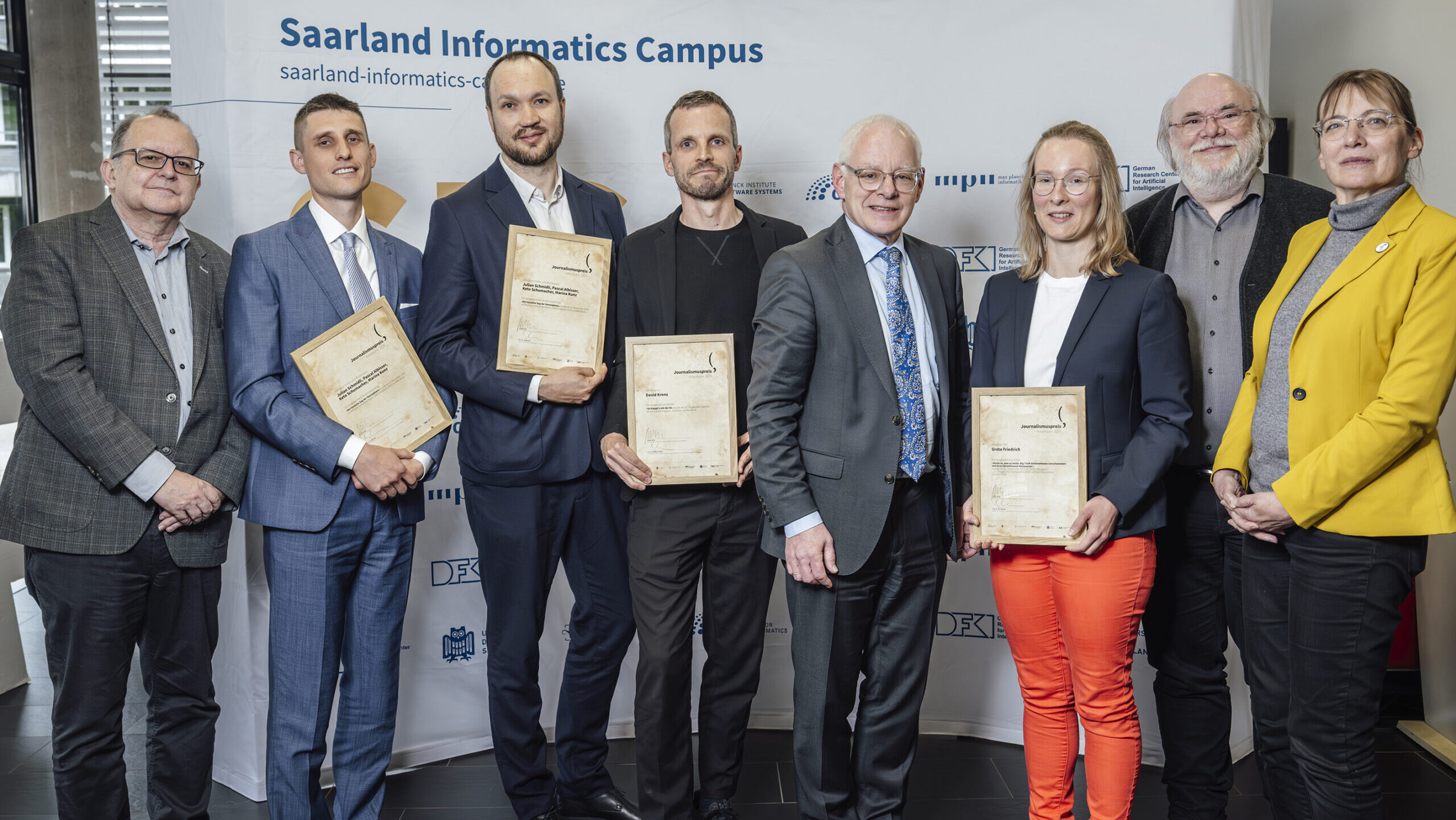
The Saarland Ministry of Economic Affairs, in cooperation with the Saarland Informatics Campus, has presented the Journalism Prize for Informatics. The German Informatics Society is a partner of the prize. The main prizes were awarded to a radio feature by Austrian Broadcasting (ORF), an article from the magazine “c’t – Magazin für Computertechnik” , and an online piece by Swiss Radio and Television (SRF). A special prize was awarded to an article in the children’s science magazine “GEOlino.”
The Journalism Prize for Informatics was first announced in 2006 and is endowed with a total of 16,000 euros. The prize money for the main awards in the three categories “Text,” “Audio,” and “Video and Multimedia,” each endowed with 5,000 euros is provided by the Saarland Ministry of Economic Affairs, Innovation, Digitalization, and Energy. Additionally, the German Research Center for Artificial Intelligence (DFKI) is once again sponsoring a special prize endowed with 1,000 euros this year. The goal of the Journalism Prize for Informatics is to promote high-quality reporting on informatics topics beyond specialist circles.
Jürgen Barke, Saarland’s Minister of Economic Affairs, Innovation, Digitalization, and Energy and patron of the prize, says: “With the Journalism Prize for Informatics, we honor outstanding and critical reporting on digital topics while strenghtening trust in complex technologies. Journalists make the opportunities and risks of informatics understandable, promote digital education, and enable citizens to form their own well-founded opinions—a central contribution to social responsibility in the age of artificial intelligence.”
This year, the jury evaluated a total of 84 submissions. The jury of the Journalism Prize for Informatics consists of Peter Bylda, a long-time editor of the Saarbrücker Zeitung and now a freelance journalist; Peter Hergersberg, editor-in-chief of the science magazine MaxPlanckForschung; Isabel Münch, Fellow of the German Informatics Society; Dr. Wolfgang Pohl, Managing Director of the nationwide informatics competitions; Florian Possinger from Saarländischer Rundfunk; Vera Sikes, Head of Department at the Federal Office for Information Security and Head of the BSI Saarbrücken office; Dr. Christel Weins, a scientist and co-founder of the journalism prize; freelance technology and science journalist Peter Welchering; and Prof. em. Dr. Dr. h.c. Reinhard Wilhelm, Professor of Informatics at Saarland University and long-time Director of the Leibniz Center for Informatics at Schloss Dagstuhl.
The main prize in the “Text” category, endowed with 5,000 euros, goes to Greta Friedrich for her article “Koste es, was es wolle: Big-Tech-Unternehmen verschwenden mit ihren Investitionen Ressourcen,” published on September 10, 2025, in the magazine “c’t – Magazin für Computertechnik” and on heise online. The article is available at:
https://www.heise.de/ratgeber/Wie-Big-Tech-Unternehmen-Umwelt-und-Mensch-gefaehrden-10508672.html
Jury’s Statement: In her article, Greta Friedrich highlights the devastating consequences of the AI boom for the environment and people. Using numerous examples and studies, she describes how major tech corporations recklessly consume resources in their “gigantomania” to stay ahead in the race for AI market leadership. The piece reports on overloaded power grids and (re)commissioned nuclear power plants supplying energy to data centers. It also addresses water shortages in regions surrounding these centers, as vast amounts are diverted to cool AI accelerators. Additionally, the article examines the psychological strain on workers fine-tuning language models. It provides an overview of the current state of affairs and compellingly argues that every use of AI should be questioned. The piece holds tech corporations accountable while raising awareness among users. An outstanding contribution to a socially explosive and highly relevant topic.
The main prize in the “Video & Multimedia” category, endowed with 5,000 euros, goes to Julian Schmidli, Pascal Albisser, Keto Schumacher, and Marina Kunz for their online article “Der toxische Sog der Manosphere,” published online on December 4, 2025, by Swiss Radio and Television (SRF). The piece is available at: https://www.srf.ch/news/schweiz/radikalisierung-auf-tiktok-der-toxische-sog-der-manosphere
Jury’s Statement: The visually sophisticated online feature by Julian Schmidli, Pascal Albisser, Keto Schumacher, and Marina Kunz powerfully demonstrates how quickly young people can be drawn into the so-called “Manosphere” on TikTok—a social media subculture defined by toxic masculinity, misogyny, and self-loathing. The piece reveals a disturbing reality: Within just five minutes of scrolling, the team’s test accounts encountered the first toxic content from this environment. A dangerously escalating trend with measurable impacts on the mental health of young men, as the authors substantiate with research. Through its multimedia approach—featuring striking graphics, embedded videos, and illustrations—the contribution explores multiple facets of the issue while creating its own compelling narrative pull, making it nearly impossible to look away. Especially relevant in the context of current debates on potential social media bans for minors, this is a highly insightful and urgent piece of journalism.
The main prize in the “Audio” category, endowed with 5,000 euros, goes to Sarah Kriesche for her radio feature „Wie Algorithmen unser Leben formen“, the fourth installment of a series on algorithms, broadcast on May 8, 2025, on Austrian Broadcasting Corporation (ORF) Ö1. The episode is available online at: https://oe1.orf.at/programm/20250508/794317/Wie-Algorithmen-unser-Leben-formen-4
Jury’s Statement: In a society increasingly shaped by algorithms, Sarah Kriesche explores a critical question: Which decisions should machines be allowed to make, and which must remain the domain of humans? The piece opens with a striking example from the Netherlands, where an AI system falsely accused people of welfare fraud for years—immediately establishing a strong sense of the stakes involved. From there, the contribution examines multiple dimensions of an algorithm-driven society: It explains the fundamentals of machine learning, addresses the problematic anthropomorphization of AI (the attribution of human traits and emotions), and tackles key questions of accountability, power, and transparency. It also considers how to empower citizens to engage critically with these systems. MAde accessible by fitting statements and musical interludes, the piece delivers an engaging listening experience while covering a breadth of topics. The jury particularly commends the meticulousness and accuracy with which this complex subject matter was handled.
The €1,000 Special Prize from the German Research Center for Artificial Intelligence (DFKI) is awarded to David Krenz for his article “So klappt’s mit der KI,” published on September 12, 2025, in GEOlino, the science magazine for children.
Jury’s Statement: In GEOlino, David Krenz takes on the challenging task of making complex computer science topics accessible to young readers. Using clear, age-appropriate language and engaging visuals, he explains how AI systems work, highlights practical applications, and addresses potential risks. Carefully selected experts help contextualize the content, while firsthand accounts from young AI users create relatable connections to children’s everyday lives. The jury particularly emphasizes the importance of introducing children to new technologies early and fostering a reflective, informed approach. David Krenz achieves this exceptionally well in his three-part series on AI, with the award-winning first installment standing out as a prime example of how to engage young audiences with cutting-edge topics.
Background Saarland Informatics Campus
1,000 researchers (including 540 doctoral candidates) from more than 80 nations make the Saarland Informatics Campus (SIC) one of the leading locations for computer science in Germany and Europe. Four world-renowned research institutes, namely the German Research Center for Artificial Intelligence (DFKI), the Max Planck Institute for Informatics, the Max Planck Institute for Software Systems, the Center for Bioinformatics as well as Saarland University with three departments and 24 degree programs cover the entire spectrum of computer science.
Editor:
Philipp Zapf-Schramm
Max Planck Institute for Informatics
Phone: +49 681 9325 4509
Email: pzs(at)mpi-inf.mpg.de