

Project explores the best of both worlds: quantum computers and classical computers
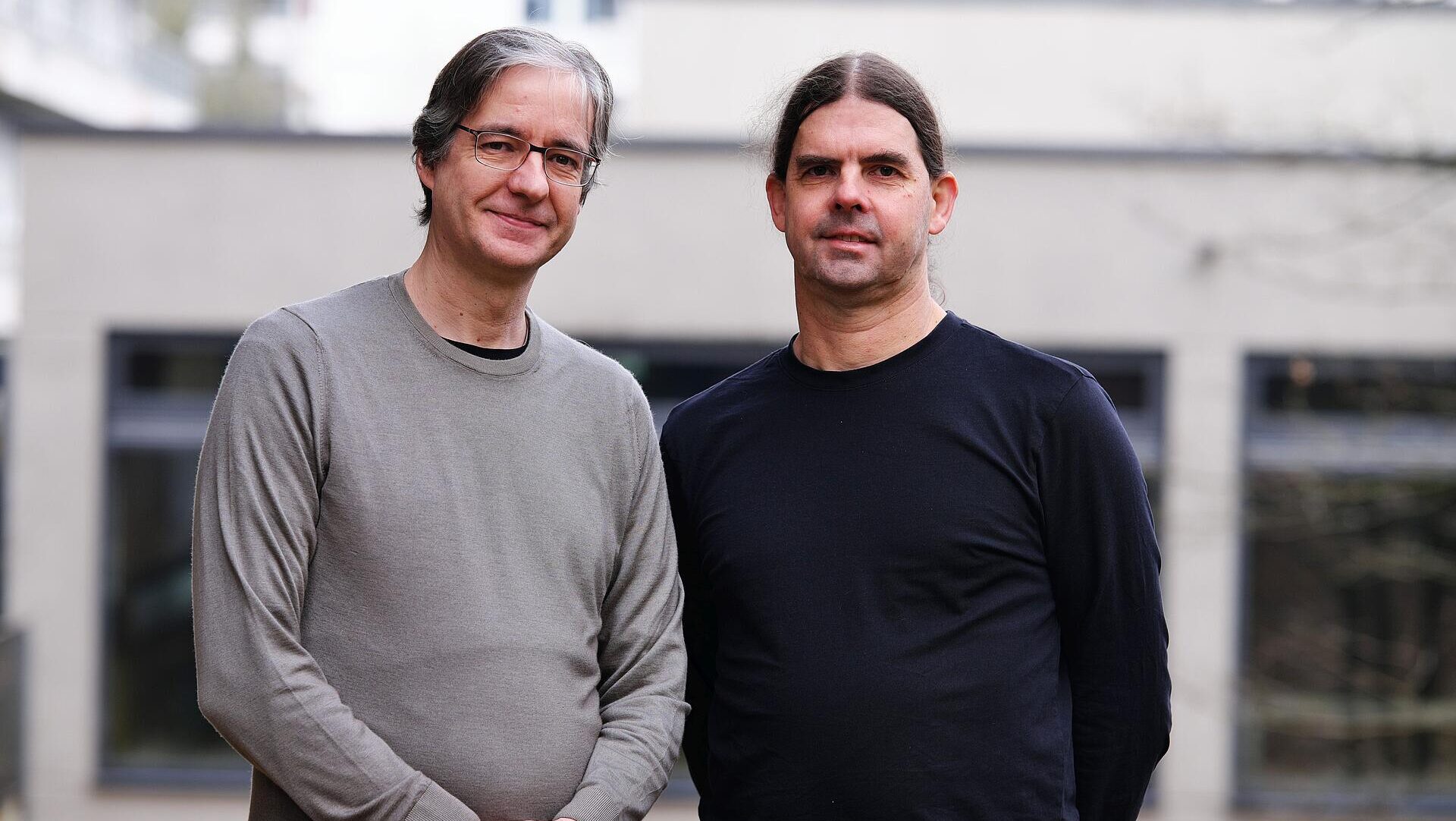
Physicist Peter P. Orth (left) and computer scientist Markus Bläser are exploring in the joint project QIAPO, together with industry partners Infineon and BMW as well as the quantum start-up planqc, how the advantages of classical computers and quantum computers can be combined.
Quantum computers can do some things better than classical computers—but many things they still cannot. Researchers at Saarland University are now working together with industry partners BMW, Infineon, and the quantum computing start-up planqc to combine both worlds. A quantum computer is intended to help classical computers tackle highly complex optimization challenges from everyday industrial practice. The project is funded with €2.3 million by the German Federal Ministry of Research.
The “traveling salesman problem” is probably the best-known example of a so-called optimization problem that poses major challenges for mathematicians: as the number of stops increases, it becomes increasingly difficult to calculate the shortest possible route that visits all locations and returns to the starting point. But such optimization problems don’t just affect salespeople—they appear everywhere in daily life, for example in manufacturing complex products or calculating prices.
Fortunately, we have computers today that can solve such problems in no time. Or do we? Not always. Even today, classical computers can often only approximate solutions to difficult mathematical problems rather than solve them completely—and often only with long runtimes. Their algorithms are typically based on real-world problems and exploit their structure heuristically. “That works surprisingly well. Algorithms that are theoretically slower can still be faster in practice,” explains Peter P. Orth, Professor of Theoretical Physics of Quantum Information at Saarland University. However, despite their quality, these solutions are often just the best possible under given circumstances—essentially: “We make the best of it; more isn’t currently possible.” But that is not enough for Peter P. Orth, his colleague Markus Bläser (a computer scientist specializing in complexity and algorithms), the industry partners Infineon and BMW, and the quantum start-up planqc.
In a new research project called “QIAPO – Quantum-informed approximate optimization on NISQ and partially fault-tolerant quantum computers,” they are therefore taking a new approach: a special quantum computer based on neutral atoms, built by planqc in Garching, will first “shrink” highly complex logistical tasks—such as those arising in the production and distribution of cars or computer chips—so that classical computers can handle them more effectively using proven algorithms. Quantum computers can outperform classical ones in certain cases because their computing units, qubits, can exist in a superposition of states 0 and 1, whereas classical bits can only be either 0 or 1. This makes quantum computers particularly well suited for solving or simplifying highly complex mathematical problems that would overwhelm classical systems.
Once the “jungle” of a mathematical problem has been cleared, researchers can continue working on classical computers using well-established algorithms to solve the now much smaller problem. However, even this hybrid approach will not yield perfect solutions for the kinds of challenges faced by companies like Infineon and BMW, Orth notes—which is why the project includes “approximate optimization” in its title. In other words, the goal is to use a combination of quantum and classical algorithms to improve solutions incrementally. For example, if a problem can currently be solved with 80% accuracy, the hybrid approach might improve this to 85% or even 95%. “This is where quantum computers could ‘fill the gap’ to increase accuracy and achieve a quantum advantage,” says Orth.
“The QIAPO project not only shows how far quantum computing has already progressed,” says Dr. Martin Kiffner, Head of Algorithms at planqc. “We are already demonstrating how highly complex, industry-relevant challenges can be translated into quantum algorithms that can ultimately be tested on quantum computers.”
Physicist Peter P. Orth describes a realistic goal of the project: “Over the next three years, we won’t immediately solve the biggest problems. But we will very likely find out whether our approach can fundamentally solve such problems—and then continue exploring them further.” After all, even small efficiency gains in complex industrial production and distribution processes could have significant impact. As the project description notes: “Even minor resource savings can lead to substantial financial effects at large production scales.”
At a glance:
The project “QIAPO – Quantum-informed approximate optimization on NISQ and partially fault-tolerant quantum computers” has been funded since January 2026 for three years with €2.33 million by the German Federal Ministry of Research, Technology and Space. It is coordinated by Prof. Dr. Peter P. Orth (Saarland University). Other participants include Prof. Dr. Markus Bläser (Saarland University), BMW AG, Infineon Technologies AG, and planqc GmbH. planqc develops quantum computers based on neutral atoms—the fastest path toward scalable quantum processors for industrial applications. Founded in April 2022 in Garching near Munich by Alexander Glätzle, Sebastian Blatt, and Johannes Zeiher, planqc is the first spin-off of the Max Planck Institute of Quantum Optics within the Munich Quantum Valley initiative.
Related Links:
www.quantensysteme.info/projektatlas/projekte/q/qiapo
www.planqc.eu
More Information:
Prof. Dr. Peter P. Orth
Tel.: (0681) 3024960
E-Mail: peter.orth(at)uni-saarland.de
Webseite: https://www.uni-saarland.de/lehrstuhl/orth.html
This text has been machine translated from the German and has undergone no postediting.