

High-Risk AI Systems and Robotics: Approximately 13 Million Euros for a Collaborative Research Center on Software Systems
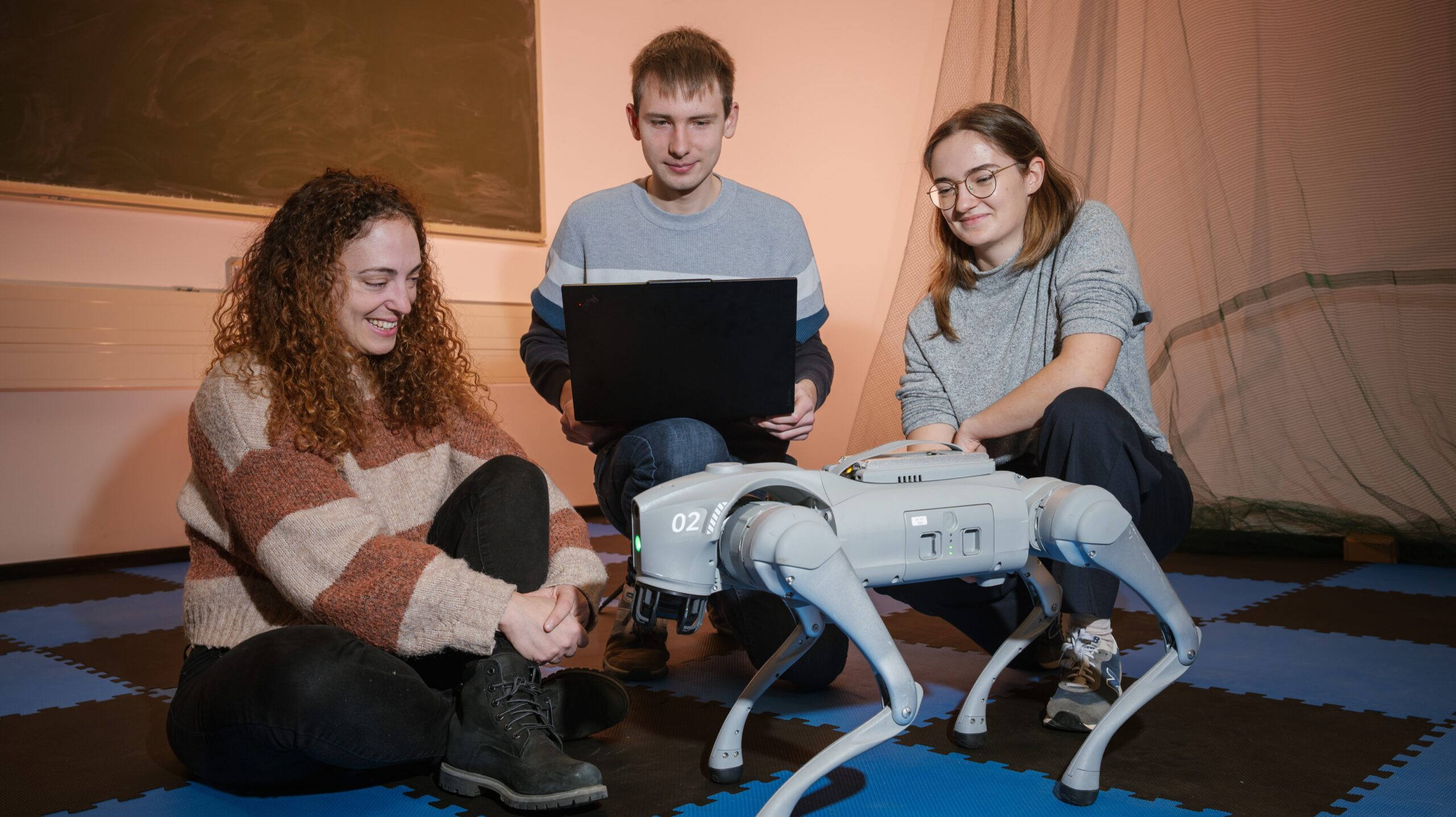
Computer science professor Martina Maggio is working with students to research how robots can respond reliably even in unforeseen situations, Photo: © Oliver Dietze/UdS
Artificial intelligence and other computer programs support medical decision-making, control vehicles, or assist in the selection of job candidates. The more complex these systems become, the more difficult it is to understand their decision-making processes. The Transregio Collaborative Research Center, which has now been extended, will therefore focus on developing computer systems whose behavior humans can understand and control.
The German Research Foundation (DFG) is once again funding this major project in its third and final round with approximately 13 million euros over four years.
The following text has been machine translated from the German with no human editing.
“If, for example, artificial intelligence is used at a university to help select the best students for certain degree programs, it must do more than just function reliably from a technical standpoint. The question also arises as to whether the AI makes a fair selection, whether data protection is adequately taken into account, and whether, ultimately, a human reviews the selection and takes responsibility for ensuring that everything proceeds correctly,” says Holger Hermanns, professor of computer science at Saarland University and currently deputy spokesperson for the Transregio Collaborative Research Center. Together with researchers from the Technical University of Dresden, he aims to develop computer systems that communicate their decisions in a way that is transparent and understandable to humans. In addition, errors in the software systems should be detected early on so that humans are able to intervene if necessary.
“In recent years, we have developed many new methods and tools in collaboration with all the computer science research institutes on the Saarbrücken campus and other partners. This allows us, for example, to mathematically verify the behavior of computer programs, detect potential errors, and clearly illustrate complex technical relationships,” says Holger Hermanns, summarizing the research conducted to date. In the third funding period, the research is set to go one step further. “In an era of rapidly evolving large language models and other complex software systems, we want to ensure that people not only understand these systems better but can also specifically influence their behavior,” says the Saarbrücken computer scientist.
Since these issues extend far beyond computer science, interdisciplinary teams from the fields of psychology, law, philosophy, and computer science are collaborating within the Collaborative Research Center. This article will illustrate the current problems being addressed by examining three subprojects at the Saarland Informatics Campus.
Human Oversight of High-Risk AI Systems
“When artificial intelligence supports important decisions, the question arises of how humans can maintain control over it,” says philosopher and computer scientist Sarah Sterz, who conducts research as a research associate under Holger Hermanns. As part of a subproject team, she has been examining the conditions that must be met for effective human oversight of high-risk AI systems. “We have developed technical methods that can be used in an AI-based selection system to detect whether individual people may be at a disadvantage. Simply putting a person in front of a screen isn’t enough. Anyone tasked with responsibly overseeing AI must sufficiently understand its decisions and be able to actually intervene,” emphasizes the Saarbrücken-based researcher.
In the new funding phase, she plans to focus even more intensively on the regulation governing the use of artificial intelligence—the EU AI Act—which took effect in 2024. “It’s not always clear how the legal requirements are to be implemented in practice. The example of college admissions shows that artificial intelligence can help universities select applicants. But what criteria should it use to make decisions? How can we prevent certain groups from being disadvantaged? Such questions cannot be answered by technical solutions or legal requirements alone,” says Sarah Sterz.
That is why she is investigating how companies and institutions can reach well-reasoned decisions even when faced with difficult trade-offs—in collaboration with Holger Hermanns, a professor of computer science; Kevin Baum, a philosopher and AI ethicist at DFKI in Saarbrücken; and Anne Lauber-Rönsberg, a professor of law at TU Dresden.
Reliable Robots in Unforeseen Situations
No matter how well a robot is programmed, things don’t always go according to plan in the real world. A drone might get caught in a gust of wind, a robot might suddenly have to swerve to avoid a person, or a computer might take longer than expected to perform an important calculation. How can such machines still operate reliably? Another subproject of the supraregional research consortium is addressing this question. The researchers are developing methods to control autonomous machines as reliably as possible, even under uncertain conditions. “The machines should not only react to changes but also take into account how their decisions affect their own safety and functionality,” explains Martina Maggio, a professor of computer science at Saarbrücken.
She wants to test whether the methods developed by her team work on real robots—including aerial drones, underwater drones, four-legged robots, and robotic arms. In this project, Martina Maggio is collaborating with computer science professor Christel Baier from TU Dresden and Anne-Kathrin Schmuck from the Max Planck Institute for Software Systems in Saarbrücken.
“We want to decide what AI assistants think they know about us”
“When you ask an AI a question, you often get the same kind of answer—regardless of how much prior knowledge you have. Yet a doctor may need entirely different explanations than her patients,” says Anna Maria Feit, a professor of computer science at Saarbrücken. In her subproject within the Collaborative Research Center, she therefore aims to develop AI assistants that can better cater to the knowledge and needs of individual people. To achieve this, the systems are designed to take into account what their users already know and where they still lack information.
“The key point here is that people should be able to understand and correct the assumptions the AI makes about them. “Anyone who is mistakenly identified as a beginner by an AI assistant should be able to change that assessment,” Anna Maria Feit explains by way of example. She is collaborating on this project with Vera Demberg, professor of computer science and computational linguistics at Saarland University, and Simon Razniewski, professor of knowledge-based artificial intelligence at TU Dresden.”
Hintergrund: Sonderforschungsbereich zu verständlichen Softwaresystemen
Since 2019, the German Research Foundation (DFG) has been funding the “Center for Perspicuous Computing (CPEC).” The research consortium has now been granted funding for the third and final funding period, thereby reaching the maximum funding duration of twelve years. A request for approximately 12.5 million euros was submitted for the years 2027 through 2030, with the majority of that amount earmarked for research staff.
The Collaborative Research Center is a joint project of Saarland University and the Technical University of Dresden. Raimund Dachselt of the Technical University of Dresden currently serves as the spokesperson for the research consortium, with Holger Hermanns as his deputy. All research institutions on the Saarland Informatics Campus are involved, including the German Research Center for Artificial Intelligence (DFKI), the CISPA Helmholtz Center for Information Security, the Max Planck Institute for Software Systems, and, most recently, the Max Planck Institute for Computer Science. In total, the “Center for Perspicuous Computing” brings together around one hundred researchers from various disciplines. In addition to the two universities and the institutions in Saarland, research partners in Freiburg, Braunschweig, and Vienna are also part of the consortium.
For more information: www.perspicuous-computing.science
You may use the press photos below free of charge in connection with this press release and coverage of Saarland University, provided you credit the photographer.
Questions answered by:
Prof. Dr. Holger Hermanns
Deputy Spokesperson for the SFB
Tel. 0681 302-5631
E-Mail: hermanns(at)cs.uni-saarland.de