

How to make AI data centres sustainable
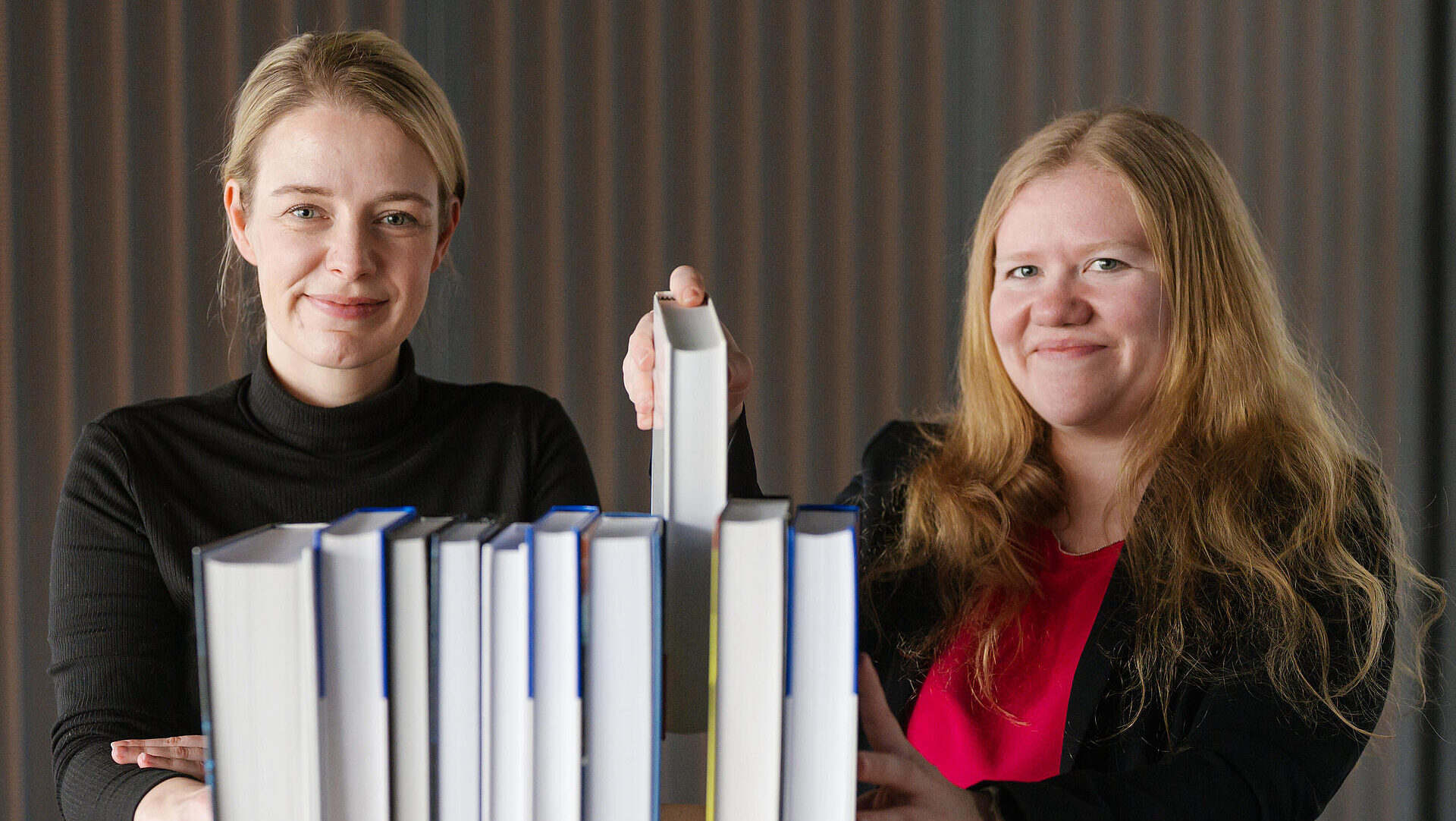
When you have a question, you don’t need the whole library; the books containing the right answers are enough. One of the methods used by researchers Sabine Janzen (left) and Hannah Stein (right) in the Escade project’s research consortium to make artificial intelligence more energy-efficient works in much the same way, Photo: © Oliver Dietze
Data centres are springing up all over the world – along with power stations designed to satisfy the energy demands of artificial intelligence. A research consortium led by Wolfgang Maaß (German Research Center for Artificial Intelligence DFKI and Saarland University) found ways to reduce AI’s electricity consumption by up to 90 per cent using hardware and software technologies.
Presseeinladung zum Projektabschluss:
To mark the conclusion of the Escade project, funded by the Federal Ministry of Research, Technology and Space, the team will present how AI can make a smaller environmental footprint while also giving small and medium-sized enterprises access to powerful AI models. The event will take place on 30 July from 10 a.m. to 1 p.m. at the DFKI on the Saarbrücken campus (D3 2) and is open to the public.
The following text has been machine translated from the German with no human editing.
Fast jeder nutzt heute auf die eine oder andere Weise Künstliche Intelligenz. Was nicht jedem bewusst ist: Auch die kleiAlmost everyone uses artificial intelligence in one way or another these days. What not everyone realises is that even the smallest response from a chatbot consumes energy and resources. Training and running AI models using vast amounts of data consumes hundreds of terawatt-hours worldwide. On a global scale, all of this leaves a massive ecological footprint. And with the rapid development of the technology, demand is set to rise sharply. New data centres will seal off vast areas of land, as will new power stations – including those fuelled by fossil fuels – which will have to supply the additional energy required. CO₂ emissions will rise just as dramatically as the water required for cooling.
A consortium led by Professor Wolfgang Maaß, who conducts research at Saarland University and the German Research Center for Artificial Intelligence e Artificial Intelligence (DFKI), is working to counteract this trend and make artificial intelligence more energy-efficient. For three years, the consortium has been investigating various methods and developing and testing new technologies. The researchers are presenting their findings at the conclusion of the project.
Compressed AI requires almost 90 per cent less energy
On the one hand, the team is focusing on smaller, more needs-based AI models to curb AI’s energy consumption and conserve resources. Today, AI uses huge data models. A chatbot, for example, utilises the entire data model – comprising trillions of parameters – to generate its response: figuratively speaking, it searches an entire library rather than just the books containing relevant content. The researchers have therefore developed AI models in which irrelevant parameters are not processed in the first place, making them more energy-efficient.
To do this, they filter out the knowledge that is truly necessary for the respective task from large teacher models and create bespoke student models that are up to 90 per cent smaller. “We’re achieving good results by compressing the AI models – in other words, making them smaller and more efficient. In our test runs, we were able to demonstrate that the student models deliver comparable performance whilst using up to 89 per cent less energy,” says Sabine Janzen, a postdoc in Wolfgang Maaß’s team. The leaner AI models, tailored to specific use cases, operate without the need for extensive infrastructure. “This makes powerful AI models accessible even to small and medium-sized enterprises, something that was previously impossible simply because of the size of the models,” says Janzen.
Automatically selecting the best AI model using 40 per cent less energy
For AI models that process and generate digital image data, the researchers use a different method known as ‘neural architecture search’. This method automatically identifies the best architecture for artificial neural networks. The team was able to demonstrate that they can reduce the size of the models by just under 90 per cent and cut energy consumption by 40 per cent. What’s more, the models do not suffer any loss of performance. “We were even able to improve the model’s accuracy with this approach,” says Sabine Janzen.
In machine learning using artificial neural networks, the learning processes are similar to those in the human brain. Whilst the human brain is a master of energy efficiency – having continuously optimised itself through evolution and processing information very efficiently – its artificial counterpart, with its efficient algorithms, requires an enormous amount of computing power and electricity: Artificial neural networks are still painstakingly assembled by humans today and fine-tuned until they deliver good results. “We are automating this process using neural architecture search. In doing so, we test various network structures and optimise them further so that the models are powerful and efficient, but cost less,” explains Sabine Janzen.
Scrap Sorting Test Case
In order to test such more energy-efficient AI methods on an industrial scale, the researchers have been collaborating with SHS – Stahl-Holding-Saar since 2022 as part of the Escade project.
SHS has developed a highly capable AI model that automatically classifies steel scrap and uses camera images to identify which type of steel scrap is being delivered to the steelworks site. Since 2024, SHS has been using its own in-house, optimised AI model to classify steel scrap: using camera images, the AI recognises the different types of scrap, enabling the steel scrap to be sorted by type before being used in production.
The aim of the Escade project was to make an AI model with roughly equivalent performance even more energy-efficient. The research team developed a high-performance visual AI model for steel scrap classification. This new model was compressed in such a way that it operates in a compact, energy-efficient manner whilst delivering performance similar to that of an AI model created using traditional methods. This makes the visual computing process more energy-efficient. To achieve this, the partners first trained the model using the complete data set and all relevant information, and then compressed it using knowledge distillation and automatically assembled neural networks. The techniques developed can, in particular, be applied to other visual AI models and can thus contribute to energy savings on a wider scale.
Further potential for savings in sustainable data centres
Furthermore, on 30 July, the consortium will highlight potential savings for data centres. Together with its partners, the Saarbrücken-based research team has developed a concept and recommendations for energy-efficient AI, which will enable data centres and AI users to plan more effectively and identify inefficient processes. To this end, the team has developed a tool that enables reliable forecasts of the exact energy consumption and costs of AI models. “This tool makes it possible, for example, to schedule processes that require high computing power for times when the price of electricity is low. Until now, decision-makers have found it difficult to estimate how much energy specific models will consume, which is why it is challenging to plan ‘ ’ in a cost-effective manner,” explains PhD student Hannah Stein, who is researching energy-saving AI methods.
Neuromorphic chip technologies
In addition, the research consortium is working on neuromorphic chip technologies in the field of hardware; these are microprocessors that also mimic the functioning of the human brain. “Our findings in this hardware area suggest that this technology also operates significantly more energy-efficiently than conventional chips: in our tests, they are already up to six times more efficient. But further research is needed here, and we need more time for that,” explains Sabine Janzen.
On 30 July, the research consortium will present its project findings on sustainable AI data centres and resource-efficient AI algorithms, including through demonstrations. Interested parties, in particular data centre operators, technology providers and companies, are invited to attend.
Registration and programme for 30 July: https://escade-project.de
Background
The ESCADE (Energy-Efficient Large-Scale Artificial Intelligence for Sustainable Data Centres) project was funded by the Federal Ministry of Research, Technology and Space (BMFTR) with around five million euros over a three-year period as part of the ‘Green Tech Innovation Competition’.
The project consortium comprises, in addition to the research team led by Professor Wolfgang Maaß as coordinator (German Research Center for Artificial Intelligence DFKI and Saarland University), the Technical University of Dresden, Bielefeld University, the Central German Data Centre NT Neue Technologie AG (NT.AG), SHS – Stahl-Holding-Saar GmbH & Co. KGaA, SEITEC GmbH, the Austrian research organisation Salzburg Research, and the subcontractors eco2050 Institute for Sustainability, SpiNNcloud Systems GmbH and elevait GmbH & Co. KG.
The project is managed by the German Aerospace Centre.
For enquiries, please contact:
Dr Sabine Janzen: Tel: 0681- 8 57 75 – 269, Email: sabine.janzen@dfki.de
Hannah Stein: Tel: +49 681 302-64739, Email: hannah.stein@iss.uni-saarland.de