
News Archive
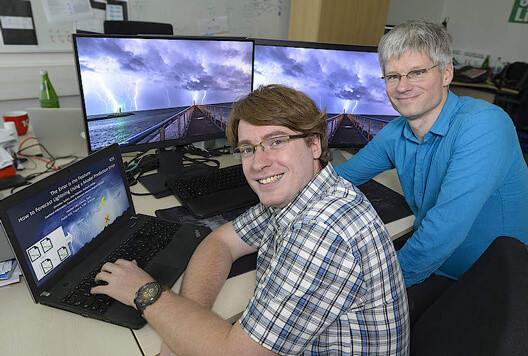
At the beginning of June, the German Weather Service counted 177,000 lightning bolts in the night sky within a few days. The natural spectacle had consequences: Several people were injured by gusts of wind, hail and rain. Together with Germany’s National Meteorological Service, the Deutscher Wetterdienst, computer science professor Jens Dittrich and his doctoral student Christian Schön from Saarland University are now working on a system that is supposed to predict local thunderstorms more precisely [...]

They prepare complex data material, analyze it using statistical and artificial intelligence methods in order to calculate previously unknown trends and facts. Such specialists are not only highly sought-after on the labour market. Even now, thousands of well-paid positions remain vacant. Saarland University is therefore introducing the bachelor’s and master’s degree program “Data Science and Artificial Intelligence” for the coming winter semester. Renowned experts from the [...]
The Department of Computer Science at Saarland University turned 50 years old as of a few days ago. While Günter Hotz was the first professor of computer science in 1969, there are now 1900 students enrolled in computer science, and around 800 scientists conduct research at the six world-renowned research institutes, which jointly operate as the “Saarland Informatics Campus” (SIC). During the last weekend in May, the Department of Computer Science celebrated its birthday with several events.
The Gesellschaft für Informatik has selected ten influential thinkers from the German history of artificial intelligence (AI). In the “Science Year 2019 – Artificial Intelligence” proclaimed by the German Federal Ministry of Education and Research (BMBF), the jury selected ten outstanding scientists who have a significant influence on AI in Germany. Five of them have also done research on the Saarland Informatics Campus (SIC).
“Chappie” is the third movie in the film series “Artificial Intelligence in Cinema” and will be shown on 28 May at 18:30 in the Filmhaus Saarbrücken. The action film from 2015 deals with an autonomous police robot that is kidnapped by street gangsters and receives human consciousness. This leads to a dramatic chain of circumstances. Cosmina Croitoru, a researcher at the Max Planck Institute for Computer Science in Saarbrücken, will then comment on the science fiction movie [...]
On the occasion of the 50th anniversary of the Department of Computer Science at Saarland University, Prime Minister Tobias Hans expressed his congratulations. During the ceremony in the evening Hans said: “The roots of today’s performance and importance of the computer science department began to grow five decades ago. They are the result of fruitful teamwork within the university as well as excellent cooperation with non-university research institutions and the IT industry, but also of [...]
Günter Hotz, retired computer science professor of Saarland University, has been appointed honorary senator of Saarland University at the symposium marking the 50th anniversary of the Department of Computer Science. Hotz, born 1931 in Rommelshausen, is considered a pioneer of German computer science. Among other things, he wrote standard works in the fields of formal languages, circuit theory and complexity theory. In 1969 he was appointed the first full professor of computer science at Saarland [...]
The Bachelor and Master program “Data Science and Artificial Intelligence” always begins in the winter semester at Saarland [...]
Human genomes vary quite a bit from individual to individual. These differences include single nucleotide change in the DNA sequence, but even more variation comes from structural variants, which include additions, deletions and rearrangements of large segments of DNA. A recent study done by Professor Tobias Marschall and international colleagues used multiple advanced technologies to dive deeper than ever before to comprehensively characterize the structural variants present in three families, and what their functional consequences might be.
On the occasion of its 50th anniversary, the Department of Computer Science of Saarland University is organizing a weekly series of lectures at the Filmhaus Saarbrücken at 6:30 p.m. starting on April 9. The lectures bridge the gap between the past and current research. Scientists who work in the institutes of the Saarland Informatics Campus will present their current projects and also discuss the history of the respective institute. The lecture series begins with Vera Demberg, who holds a professorship [...]
Professor Andreas Keller from the Center for Bioinformatics at Saarland University is leading a research project at Stanford University in Silicon Valley for one year. The aim is to gain a better understanding of how diseases such as Alzheimer’s and Parkinson’s develop in the human body at the single-cell level. The aim is to identify such widespread diseases earlier and open up new therapeutic options. The Schaller-Nikolich Foundation in Heidelberg is financing the stay with one million US dollars.
“Robot & Frank” is the second film in the film series “Artificial Intelligence in Cinema” and will be shown on April 1 at 6:30 p.m. at the cinema in the Filmhaus Saarbrücken. The story recounts the special friendship between a demented jewel thief and his care robot. Afterwards Jan Alexandersson, head of the Competence Center for Ambient Assisted Living (CCAAL) at the German Research Center for Artificial Intelligence, will comment on the American independent film from [...]
Yesterday evening Mayor Charlotte Britz awarded the honorary citizenship of the state capital Saarbrücken to Professor Wolfgang Wahlster. With this award, the city of Saarbrücken honors Wahlster’s achievements “in the successful establishment and further development of Saarbrücken as a leading location for information technology “. This makes Wahlster the first scientist to receive this honor. Wolfgang Wahlster, born in Saarbrücken in 1953, studied computer science and computational [...]
“IT Inkubator GmbH“ at Saarland University is offering a new, nationwide start-up program to ensure that start-ups can be established more quickly and successfully. The aim is not only to transform the ideas and inventions developed on the Saarland Informatics Campus into products, services and spin-offs. Students and researchers from other universities and research institutes can also use the new program to set up companies or advance their technology to such an extent that established industrial [...]
With the British film “Ex Machina”, the film series started last week in the Filmhaus Saarbrücken cinema. Around 90 people attended [...]
2324252627 ...
31»