
News Archive
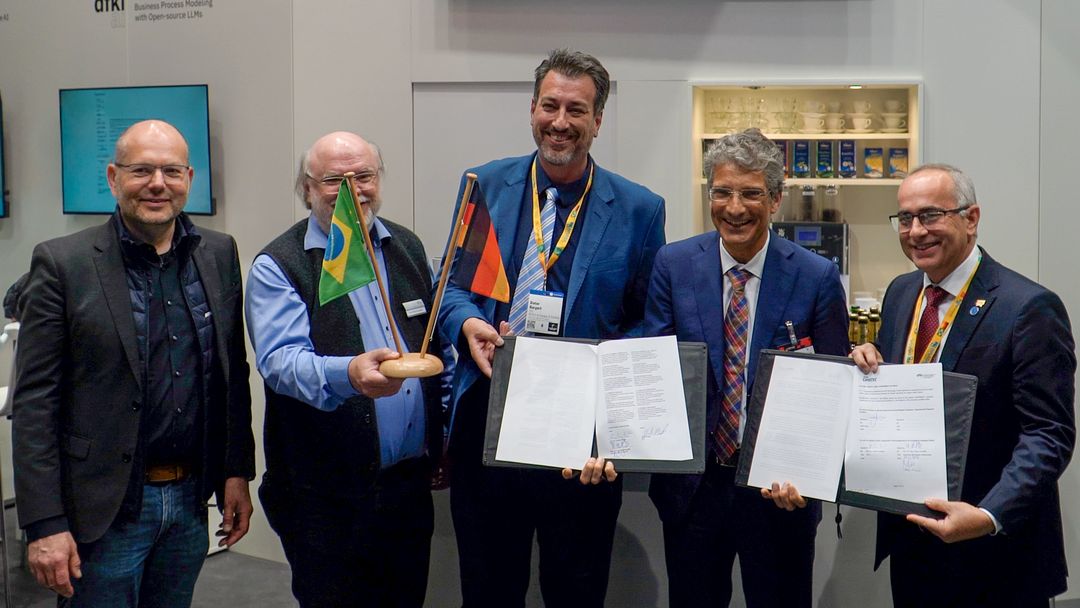
Kaiserslautern/Bremen/Hanover – The German Research Center for Artificial Intelligence (DFKI) is further expanding its international activities: At the Hannover Messe, the DFKI is signing two Memoranda of Understanding (MoUs) with Brazilian organizations in the field of artificial intelligence and applied research – its long-standing partner SENAI CIMATEC and the innovation hub NEXUS AI Campus. The agreements are part of German-Brazilian cooperation: Brazil is the partner country of this year’s [...]

How can artificial intelligence be effectively transitioned from research to real-world use? At Hannover Messe 2026, the German Research Center for Artificial Intelligence (DFKI) will demonstrate how AI solutions can be deployed in an economically viable, socially responsible, and technologically autonomous way. From April 20 to 24, DFKI will showcase practical AI technologies and transfer methods in Hall 11, Booth B30, as well as at partner booths, thereby strengthening Germany as an innovation hub and bridging scientific excellence and practical application.
Making virtual worlds tangible is one of the key challenges in the field of human-computer interaction. While vision and hearing are already well integrated into virtual and augmented reality (VR and AR), the sense of touch still lags behind. The Sensorimotor Interaction group, led by Dr. Paul Strohmeier at the Max Planck Institute (MPI) for Informatics, is researching how to change this. Two papers written by the group in collaboration with Saarland University and international partners will now [...]
The EATCS Award for the best theory paper at ETAPS 2026 was awarded to Isa Vialard, Joël Ouaknine and Quentin Guilmant for their paper “The value problem for weighted timed games with two clocks is undecidable”, published in FoSSaCS 2026. The EATCS award is given each year to the best ETAPS papers in theoretical computer science.
Am 22. April findet der UdS-KI-Tag für Studierende im Innovation Center (Gebäude A2 1) statt. Der Untertitel lautet: „Entdecke, wie KI dir hilft, effizienter zu studieren, dich gezielt auf deine berufliche Zukunft vorzubereiten und eigene Lernagenten zu entwickeln – präsentiert von der Universität des Saarlandes und dem AStA mit Microsoft als besonderem Gast“. Die Veranstaltung wird von der Stabsstelle Digitalisierung, ZeLL, dem Dezernat Lehre und Studium, dem DFKI und dem AStA organisiert
The Saarland state government announced last June that it would support the establishment of a Center for Quantum Technologies (QuTe) at Saarland University with more than €53 million in funding. Today, the center officially begins its work with a ceremonial kick-off event. Among those attending are Minister Jakob von Weizsäcker, University President Ludger Santen, and Astrid Lambrecht, Chair of the Board of Directors of Forschungszentrum Jülich, which will work closely with the new center.
Even the best AI language models — so-called large language models — can be significantly off the mark when it comes to logical questions. In such cases, calculations are incorrect, sequences are reproduced incorrectly, or the AI hallucinates and invents false statistics or quotes. Michael Hahn, a computational linguist at the Department of Language Science and Technology and Computer Science, has already produced promising research results addressing this problem. For this work, he has now been [...]
Städte enthalten enorme Mengen an wertvollen Materialien, die in bestehenden Gebäuden verbaut sind und bei Sanierungen oder Rückbauten häufig ungenutzt verloren gehen. Genau hier setzt Urban Mining an: Es betrachtet Gebäude als Materiallager und zielt darauf ab, vorhandene Baustoffe und Bauteile systematisch zu erfassen und wiederzuverwenden, statt sie zu entsorgen. Urban Mining spielt somit eine entscheidende Rolle für die klimaneutrale Transformation der Bauwirtschaft. Das Forschungsprojekt [...]
MPI-SWS scientific director Joël Ouaknine was appointed as a Fellow by the European Association for Theoretical Computer Science (EATCS). Joël, who leads the “Foundations of Algorithmic Verification” research group, was appointed EATCS fellow for “fundamental contributions to the algorithmic analysis of dynamical systems and related formalisms.”
Thinking about a Master’s in Computer Science, Visual Computing, or Embedded Systems in Germany and not sure how programs work, what admissions look for, or how to compare universities? [...]
Quantum computers can do some things better than classical computers—but many things they still cannot. Researchers at Saarland University are now working together with industry partners BMW, Infineon, and the quantum computing start-up planqc to combine both worlds. A quantum computer is intended to help classical computers tackle highly complex optimization challenges from everyday industrial practice. The project is funded with €2.3 million by the German Federal Ministry of Research.
Max Planck researchers investigate “quantum neural networks” as a building block for more efficient visual-computing models. The “4D Quantum Computer Vision” research group at the Max Planck Institute (MPI) for Informatics in Saarbrücken, Germany, is investigating the potential of quantum computing for computer-based image processing, also known as visual computing. A new hybrid model, developed together with partners from the University of Udine and the University of Naples Federico II, [...]
The new graduate school will develop advanced AI methods for basic life sciences research. The school will focus on deepening understanding of biological systems by combining modern biomedical technologies with innovative approaches to artificial intelligence. The aim is to train a new generation of scientists who will develop algorithms that can learn, explain, and predict the principles of living systems and use these findings for molecular design.
Artificial intelligence today is largely based on statistical methods that search for patterns in large amounts of data. So far, AI cannot recognise causalities, meaning it cannot understand how cause and effect are related in the same way that humans can. Computer science researcher Sara Magliacane wants to change that. Saarland University has now appointed her Professor of Machine Learning.
The Harlan D. Mills Award is the most important international distinction in the field of software engineering, honoring scientists for their lifetime achievements. Andreas Zeller has now received this honor—only the second German to do so. He is a researcher at the Helmholtz Center for IT Security (CISPA) and a professor of software engineering at Saarland University.
31»